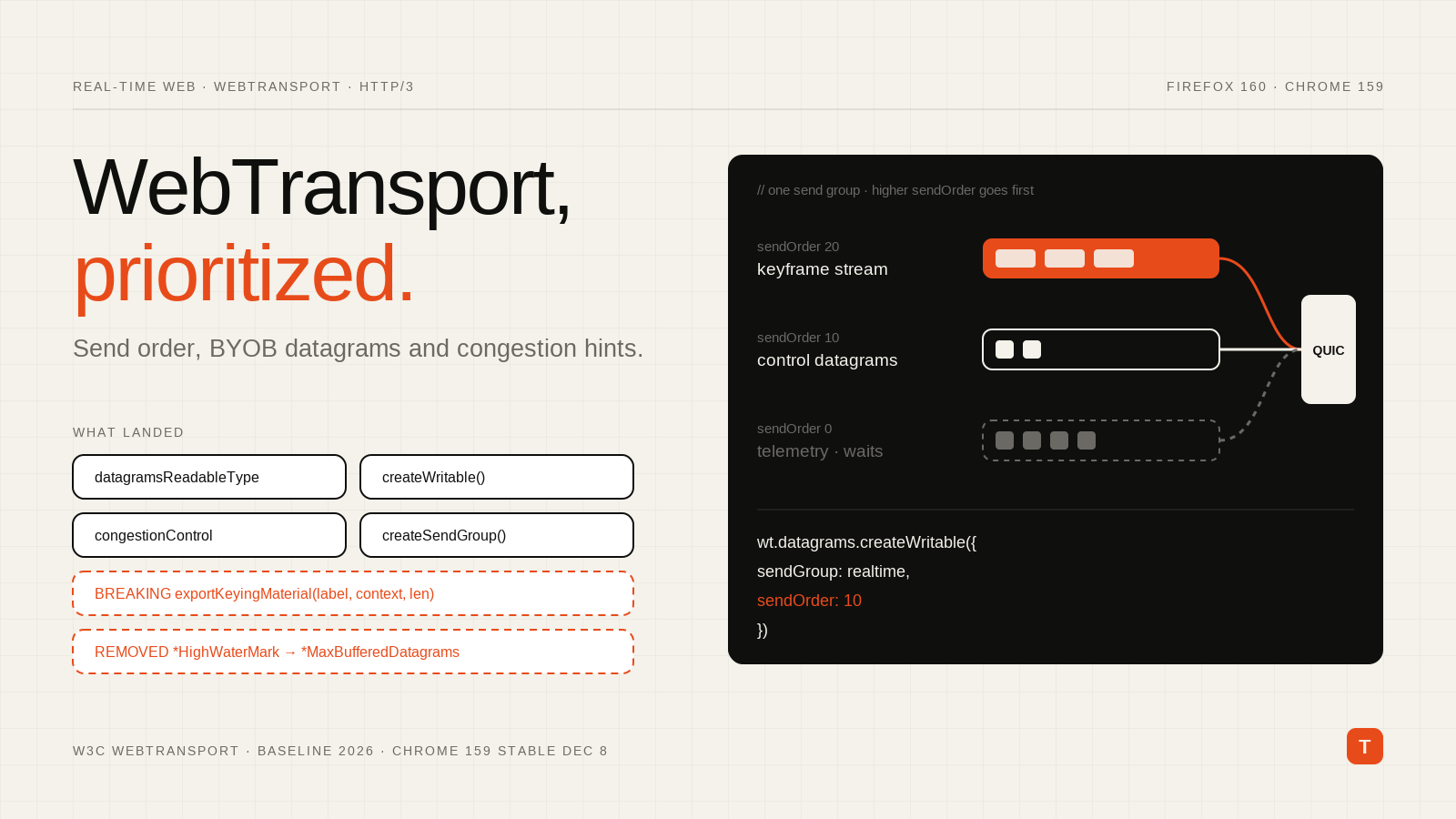
WebTransport has been around long enough to be boring, which is a good thing. MDN marks it Baseline 2026, newly available since March 2026, so a real-time app can now count on HTTP/3-based streams and unreliable datagrams in every current browser. The first version of the API was rough in places, though. Datagrams had a single writable with no priority, reading meant allocating a new chunk per packet, and each engine had its own vendor-specific tuning knobs.
This month both Chromium and Gecko caught up with the current W3C WebTransport spec at nearly the same time. Firefox 160 shipped on November 10, and Chrome 159 is in beta, with stable due on December 8, 2026. If you run live media, multiplayer, collaborative cursors or telemetry over WebTransport, this is the release pair to test against. One of the changes also breaks existing code.
What shipped, side by side
| Change | Firefox 160 | Chrome 159 |
|---|---|---|
datagramsReadableType: "bytes" (BYOB datagram reads) |
Shipped | Shipped |
exportKeyingMaterial(label, context, outputLength) |
Updated to spec (breaking) | Shipped |
incomingMaxBufferedDatagrams / outgoingMaxBufferedDatagrams |
Shipped, replacing non-standard high-water marks | — |
headers constructor option + responseHeaders |
Shipped | — |
datagrams.createWritable() with sendGroup / sendOrder |
— | Shipped |
Send groups and sendOrder for outgoing streams |
— | Shipped |
congestionControl option and attribute |
— | Shipped |
WebTransportReceiveStream.getStats() |
— | Shipped |
A dash means the item isn't in that release's notes. It doesn't tell you whether the engine already supported it, so feature-detect rather than sniffing versions.
Zero-copy datagram reads with BYOB
By default, transport.datagrams.readable is an ordinary ReadableStream that hands you a fresh Uint8Array for every datagram. At a few thousand packets per second, that's a lot of short-lived allocations for the garbage collector to chase, and it competes with your rendering work for main-thread time.
Both engines now support the datagramsReadableType constructor option. Set it to "bytes" and the datagram stream becomes a readable byte stream, so you can read with a ReadableStreamBYOBReader into a buffer you own:
const wt = new WebTransport('https://rt.example.com:4433/session', {
  datagramsReadableType: 'bytes',
});
await wt.ready;

const reader = wt.datagrams.readable.getReader({ mode: 'byob' });
let buffer = new ArrayBuffer(64 * 1024);

while (true) {
  const { value, done } = await reader.read(new Uint8Array(buffer));
  if (done) break;
  handleDatagram(value);   // a view over exactly one datagram's bytes
  buffer = value.buffer;   // BYOB transfers the buffer; take it back to reuse
}
Two details matter here. First, a BYOB read transfers the ArrayBuffer you pass in, so the original reference is detached afterwards. Always continue with value.buffer. Second, because that buffer is reused, handleDatagram must finish with the bytes (decode them, copy them or post them to a worker) before the next read overwrites them.
Feature detection is easy. If the option isn't supported, getReader({ mode: 'byob' }) throws a TypeError. Catch it and fall back to a default reader.
Prioritizing what matters: send groups and sendOrder
This is the most useful change in Chrome 159. The spec has dropped the single datagrams.writable in favor of datagrams.createWritable(options), which returns as many WebTransportDatagramsWritable streams as you need. Each one carries a sendGroup and a sendOrder.
The spec's rule is short. Within a send group, data with a higher sendOrder goes first. Sending of lower-order data "MUST starve" until higher-order data queued in the same group has been sent, unless that data is errored or blocked by flow control. The default null group counts as a group too.
const realtime = wt.createSendGroup();

// Input and control messages beat telemetry, every time.
const control = wt.datagrams.createWritable({ sendGroup: realtime, sendOrder: 10 });
const telemetry = wt.datagrams.createWritable({ sendGroup: realtime, sendOrder: 0 });

const controlWriter = control.getWriter();
await controlWriter.write(encodeInput(lastInput));
Chrome 159 also extends send groups and sendOrder to outgoing streams, so reliable and unreliable traffic can share one scheme:
const keyframe = await wt.createUnidirectionalStream({
  sendGroup: realtime,
  sendOrder: 20,
});
Engines that predate this still expose the older single writable, so wrap the difference once:
function datagramWritable(wt, opts) {
  return 'createWritable' in wt.datagrams
    ? wt.datagrams.createWritable(opts)
    : wt.datagrams.writable; // legacy: one stream, no priorities
}
The fallback still works, but every datagram competes on equal terms. Treat priorities as an enhancement, not a correctness guarantee.
Asking for low latency (and checking whether you got it)
Chrome 159 adds a congestionControl constructor option with three values: "default", "throughput" and "low-latency". There's a matching read-only attribute. The spec treats the option as a request. If the browser has no congestion control algorithm that suits the preference, it falls back to "default", so read the attribute after connecting:
const wt = new WebTransport(url, { congestionControl: 'low-latency' });
await wt.ready;

if (wt.congestionControl !== 'low-latency') {
  // Not honoured: lean harder on your own jitter buffer and bitrate adaptation.
}
For interactive media and games, "low-latency" is the right ask. For bulk uploads over the same origin, open a separate session with "throughput". Don't try to serve both traffic shapes on one connection with one setting.
Bounded buffers instead of vendor knobs
Firefox 160 removes its non-standard incomingHighWaterMark and outgoingHighWaterMark and replaces them with the spec's incomingMaxBufferedDatagrams and outgoingMaxBufferedDatagrams on WebTransportDatagramDuplexStream. The two directions behave differently. When the incoming queue overflows, the oldest datagrams are dropped from the head of the queue. The outgoing limit is the sink's queue length, so a full queue applies backpressure to your writer.
For real-time data, a small incoming buffer is usually what you want. A stale position update is worse than none:
if ('incomingMaxBufferedDatagrams' in wt.datagrams) {
  wt.datagrams.incomingMaxBufferedDatagrams = 32;
}
If any code sets the old *HighWaterMark properties, it now silently does nothing in Firefox. Search your codebase for them.
The breaking one: exportKeyingMaterial()
exportKeyingMaterial() derives secret bytes from the TLS session underlying the connection. It's handy for channel binding: you can prove that an application-level token is tied to this exact connection. The spec signature is now:
Promise<Uint8Array> exportKeyingMaterial(label, context, outputLength)
Per the Firefox 160 notes, the method used to return 32 bytes regardless of arguments. Now context is required and outputLength sets the length, so callers that omit either argument need updating. Chrome 159 ships the method with the same shape. Write calls that pass all three arguments explicitly:
const enc = new TextEncoder();
const binding = await wt.exportKeyingMaterial(
  enc.encode('EXPORTER-example-app-binding'),
  new Uint8Array(0), // empty context, passed explicitly
  32,
);
Your server has to derive the same value with the same label, context and length, so coordinate the change with whoever owns the backend.
A few smaller additions
- Custom handshake headers (Firefox 160). The constructor accepts a
headersoption for the extendedCONNECTrequest, and the server's reply is exposed aswt.responseHeaders. The spec rejects aWT-Available-Protocolsheader here with aTypeError. - Receive-side stats (Chrome 159).
WebTransportReceiveStream.getStats()reportsbytesReceivedandbytesRead. The gap between them shows how far your app is lagging behind the network. Watch it as a health metric. - On-device speech (Firefox 160). This isn't WebTransport, but it's in the same release: Web Speech API recognition now runs on-device on desktop for 40 languages.
Takeaways
- Run your real-time suite in Firefox 160 now and in Chrome 159 beta before December 8. Most of these changes add features, but the old
*HighWaterMarkproperties and shortexportKeyingMaterial()calls will break. - Move hot datagram paths to BYOB reads with
datagramsReadableType: 'bytes'. The change is small and removes per-packet allocations. - Wrap
createWritable()in a helper with a legacy fallback, then give control traffic a highersendOrderthan telemetry or bulk data. - Request
congestionControl: 'low-latency'for interactive sessions, and always read the attribute back. It's a hint, not a promise. - Feature-detect everything. The two engines shipped overlapping but different subsets of the spec this cycle, and version sniffing will fail you sooner than you expect.
WebTransport no longer needs selling. What's left is polish, and this release pair delivers a lot of it. Teams running latency-sensitive features over WebSockets because "WebTransport isn't ready" should revisit that decision this quarter.